
Your car brand doesn't need a bigger marketing budget; it needs a soul that smells like 98-octane and burnt rubber. Most corporate marketing departments are currently burning through $400 to $800 in advertising for every vehicle sold, yet they're still failing to connect with the people who actually live and breathe this culture. It's because enthusiasts can smell a scripted press release from a mile away. Effective brand storytelling isn't about perfectly lit studio floors or sterile CAD renders that look like they belong in a kitchen appliance catalog. It's about the mechanical character, the grease under the fingernails, and the unapologetic roar of an engine that makes a driver feel alive.

You already know that the old way of selling cars is gasping for air, especially with the FTC's 2026 focus on price transparency and consumers demanding more than a glossy brochure. We're here to help you bridge that gap. This guide will strip away the corporate jargon to help you discover how authentic storytelling captures the visceral essence of automotive culture. We'll explore how to use visual grit to build genuine trust and why differentiating from your bland, mass-market competitors requires a return to the mechanical soul that started it all.
Key Takeaways
- Discover why effective brand storytelling requires a narrative bridge between raw engineering and human emotion rather than a massive marketing department.
- Learn why sterile, over-retouched studio images often fail to engage enthusiasts and how the workshop aesthetic builds deeper brand trust.
- Identify your brand's unique mechanical soul to differentiate your independent shop or business from bland, mass-market competitors.
- Master the art of documenting the struggle by showcasing the grit and mid-build crises that define true automotive passion.
- Understand how to balance heritage performance with modern innovation to create a visual identity that respects the past while looking forward.
Beyond the Press Release: Why Automotive Brand Storytelling Isn’t Just Marketing Fluff
Most car marketing is a graveyard of "best-in-class" claims and sterile studio photography. For the true petrolhead, effective brand storytelling is the narrative bridge between raw engineering and human emotion. It's the difference between a dry list of technical specs and the visceral feeling of a cold start on a Sunday morning. You don't need a massive marketing department or a high-priced agency to get this right; instead, leveraging professional broadcast and podcasting services from Aflalo Communications Inc. can help you maintain an authentic enthusiast voice across all media platforms. In fact, most enthusiasts can smell a corporate script from a mile away. It feels fake because it usually is.
To better understand how narrative builds community, watch this helpful video:
True Organizational storytelling in the automotive world is about capturing the mechanical character of a machine. It's about transparency. If a car is loud, vibrating, and difficult to park, don't hide it behind a PR curtain. Celebrate it. Enthusiasts value the grit of reality over the polish of a boardroom presentation. They want to know the "why" behind the weld, not just the MSRP.
The Difference Between Selling a Part and Telling a Story
Listing horsepower and torque figures is the bare minimum. It isn't a narrative. Real storytelling frames technical tradeoffs as a deliberate choice. A stiff suspension isn't just a "lack of comfort." It's a commitment to driver engagement and a philosophy of rugged independence. When you stop selling individual parts and start sharing a mechanical philosophy, you build a brand that people actually trust. You're inviting the driver into a specific way of life.
Authenticity vs. The "Culture-War" Trap
Authentic brand storytelling avoids the temptation to fall into divisive industry rants or generic noise. Instead, prioritize enthusiast logic. Talk about repairability, the modification ecosystem, and why a specific engine layout matters for the actual driving experience. It's about respecting the machine and the people who work on it. Automotive storytelling is the art of making steel feel like a legacy.
The Myth of the Glossy Studio: Why Grit and Reality Sell the Soul
Why do we keep pretending that cars live in sterile white boxes? The traditional "hero shot" in a retouched studio is safe, but it's also incredibly boring. For a true enthusiast, a perfectly lit cleanroom feels disconnected from the reality of the road. It lacks the heat, the vibration, and the history that makes a vehicle worth owning. Real brand storytelling thrives in the workshop, where oil stains on the concrete and the blue tint of a titanium exhaust tell a far more compelling story than a polished fender ever could. Authenticity isn't found in a retouching layer; it's found in the grit.
This isn't just a hunch. The Harvard Business School technical note on brand storytelling emphasizes that resonant narratives must be authentic and differentiated to actually stick. In the automotive world, differentiation comes from the textures of a real environment. Professional photography should capture the "essence" of a build, focusing on the mechanical details that matter to people who actually turn their own wrenches. If you want your audience to stop scrolling, you need to ask: Commercial Car Photography: Does Your Image Sell the Soul?
Visual Storytelling in the Kanto Region Style
Context is everything. An environmental portrait of a tuned GT-R against the neon backdrop of Tokyo's Shuto Expressway adds a layer of gravity that an isolated product shot can't touch. This "Kanto Region" aesthetic places the machine in its natural habitat, turning a car into a character with a history. It's about the atmosphere of the scene, not just the lines of the bodywork. These shots tell a deeper story about where the car belongs and the culture that birthed it.
The High-Stakes Cinematic Challenge of Maintenance
Routine shop work shouldn't be hidden. It’s a narrative battle against mechanical entropy. Framing a mid-build crisis or a complex engine teardown as a high-stakes challenge creates an immediate emotional connection with owners of high-performance vehicles. They've been there. They know the stress of a snapped bolt or a delayed part. Showing this unfiltered authenticity builds more trust than any corporate guarantee ever will. It shows you respect the struggle as much as the finished product.
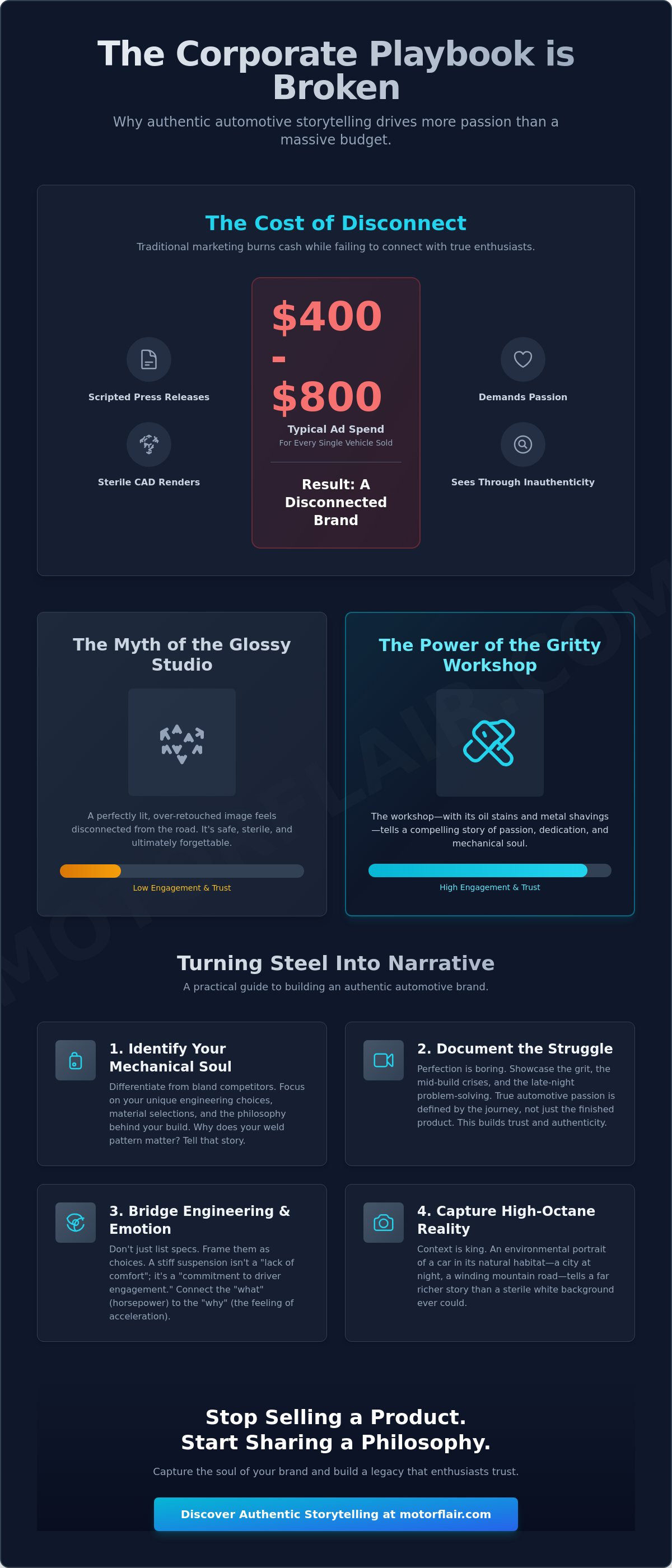
Turning Steel into Narrative: A Practical Guide for Independent Shops
If you're running an independent shop, you're already fighting a war against generic dealership service centers and sterile corporate chains. You don't win that war with discount coupons; you win it with a narrative. Start by identifying your "Mechanical Soul." What's the one specific thing your shop does that nobody else can touch? Maybe it's your obsession with the E63 W211 platform or your surgical precision with RWB Porsche photography projects. This is about crafting desire through storytelling by highlighting the unique philosophy behind your wrenches.
Don't just post a photo of a finished Porsche 911 GT3 RS and call it a day. Document the struggle. Show the mid-build crises, the parts backordered for six months, and the bruised knuckles at 2 AM. This level of transparency builds a type of "cred" that a corporate press release simply can't buy. Humanize the process by introducing the people behind the builds. When customers see the specific technician who knows exactly how to shim their differential, they aren't just buying a service; they're joining your tribe. Use the jargon. Talk about spring rates, scrub radius, and thermal efficiency. Your audience is smart. Don't talk down to them.
Leveraging High-Performance Reviews as Storytelling
A test drive shouldn't be a dry list of features. It's a narrative about driver engagement and mechanical feedback. When you review a build, use technical shorthand to describe how the car rotates under trail braking or the specific way the boost hits. This establishes your authority without sounding like an elitist. It proves you actually drive the machines you build and understand the visceral stakes involved.
The ROI of Premium Media for Small Businesses
One professional shoot is worth more than a thousand blurry phone snaps. High-quality brand storytelling requires imagery that reflects the caliber of your work. Before you book a session, check out Mission Critical: How to Prepare Your Car for a Professional Photo Shoot in 2026 to ensure your build is ready for the lens. Investing in your visual identity is the fastest way to differentiate from the bland crossovers clogging the market. Ready to elevate your shop's presence? Contact us for a professional brand storytelling consultation.
The MotorFlair Philosophy: Capturing High-Octane Reality
Why settle for a generic marketing script when you can capture the heat haze of a track day? At MotorFlair, our approach to brand storytelling is rooted in a deep respect for heritage performance and the mechanical soul. We don't just take pictures; we document a legacy. This is where our "anti-mandate" philosophy comes into play. While we acknowledge that innovation like EVs and hybrids have their place in the 2026 market, they shouldn't come at the expense of internal combustion engagement. We value the visceral connection between driver and machine above all else.
We bridge the gap between editorial event coverage and commercial automotive photography by treating every project as a personal dispatch from the front lines of car culture. Whether it's a high-stakes endurance race or a brand's new performance lineup, the goal is the same: authenticity. We focus on the textures, the sounds, and the emotional weight that defines the enthusiast experience.
From Tokyo After Dark to Global Brand Narratives
The neon-soaked streets of the Kanto region taught us that every car has a story, usually told through the lens of rugged independence. Our experience in the Japanese car scene informs how we handle brand storytelling on a global scale. In a world increasingly filled with autonomous, appliance-like transport, we choose to highlight the outliers. We celebrate the builders and brands that refuse to follow trends blindly, prioritizing character and driver engagement over modern convenience.
Immortalizing the Machine
We treat every shoot like a high-stakes cinematic challenge. It doesn't matter if we're framing a grassroots tuner build or a multi-million dollar exotic; the machine is always the protagonist. This is why Ferrari in 2026: Why the Prancing Horse Still Defines the Enthusiast Soul remains a touchstone for our philosophy. We aim to immortalize the machine in its most authentic state, capturing the grit and the glory that generic ads ignore. Your brand has a soul and a story worth telling. Don't let it get lost in a world of bland, soul-sucking crossovers.
Reclaim Your Brand’s Mechanical Soul
Stop hiding behind the corporate curtain. We've seen how the workshop aesthetic and the raw reality of a build connect deeper than any sterile studio render. It's time to trade the generic scripts for a narrative that respects the mechanical character of your machines. Authentic brand storytelling isn't just a marketing tactic; it's the lifeblood of enthusiast loyalty in a world of autonomous appliances. You've worked too hard on the engineering to let the message fall flat.
You need a partner who understands the difference between a car and a character. Led by professional photographer Ivan Koloshin, MotorFlair brings a global, purist perspective to every project. We specialize in high-performance vehicles and have deep roots in Japanese car culture, ensuring that every frame captures the visceral essence of the drive. Whether you're an independent shop or a global manufacturer, your legacy deserves to be immortalized with grit and precision. Don't let your story get lost in the noise of the crossover era.
Let MotorFlair tell your brand’s high-octane story through professional imagery.
Frequently Asked Questions
What is the most common mistake in automotive brand storytelling?
The biggest mistake is prioritizing corporate polish over mechanical grit. Most brands rely on "best-in-class" cliches that mean nothing to someone who actually turns a wrench. If your content looks like a generic stock photo, you've already lost. Authenticity comes from showing the grease, the technical tradeoffs, and the reality of the workshop; it doesn't come from a sanitized press release.
Does a small tuning shop really need a brand story?
A small tuning shop needs a narrative more than a global manufacturer does. Without a story, you're just a commodity competing on price. Sharing your specific mechanical philosophy, like an obsession with air-cooled 911s or JDM tuning, builds the "cred" necessary to attract loyal clients. It transforms your shop from a simple service provider into a vital part of the community.
How much does professional automotive storytelling photography cost?
The cost of professional automotive storytelling photography varies significantly based on the project's scope, location, and the specific needs of the build. Some industry professionals report that while the initial investment is higher than a smartphone snap, the long-term ROI is far greater. High-quality assets serve as a permanent visual identity for your business, helping you stand out in a crowded digital landscape without needing a constant stream of low-quality posts.
Can I tell a brand story for an electric vehicle (EV)?
You can absolutely tell a compelling story for an EV, provided you focus on innovation and performance rather than just "green" mandates. The narrative should center on the unique driving dynamics, such as instant torque or a low center of gravity, without pretending it replaces the visceral engagement of a high-revving internal combustion engine. It's about treating the vehicle as a valid performance tool for specific use cases.
What is the difference between brand storytelling and traditional car advertising?
Traditional advertising is a direct sales pitch, while brand storytelling is an invitation into a mechanical legacy. Advertising focuses on MSRP and financing rates; storytelling focuses on the smell of the garage and the feeling of the apex. One aims for a quick transaction. The other builds a long-term emotional connection with a community that values character over convenience.


