
The Tesla cybertruck isn't just a vehicle; it's a brutalist middle finger to every design convention we've held dear since the first internal combustion engine roared to life. You're probably tired of the endless shouting matches where one side treats it like a religious icon and the other dismisses it as a low-poly tech experiment gone wrong. Let's face it, as petrolheads who value mechanical engagement over marketing hype, the noise is deafening. You want to know if there's a real machine under that cold-rolled steel or just a collection of clever software hacks.

We're cutting through the static to evaluate this polarizing polygon through the lens of a true enthusiast. You'll discover if the $99,990 Cyberbeast actually possesses a soul beyond its 2.6-second sprint and whether the new $59,990 Dual-Motor AWD variant is a legitimate tool or a depreciating status symbol. We'll examine the grim reality of the May 2026 sales trends, the truth behind those bulletproof claims, and the practical tradeoffs of a stainless steel body that some owners are calling a repairability nightmare. It's time to find out if there's a genuine driver's experience hidden beneath the sharp edges.
Key Takeaways
- Separate the "exoskeleton" marketing from the unibody reality and discover why the stainless steel finish demands more upkeep than a traditional clear coat.
- Evaluate if the cybertruck steer-by-wire system offers a genuine evolution in driving dynamics or simply masks the physics of a 7,000-pound machine.
- Identify the specific repairability challenges that make the stainless steel panels a potential nightmare for independent body shops and DIY enthusiasts.
- Discover the logistical absurdity of navigating this 223-inch beast through the tight corners of Ginza and Tokyo's narrowest alleys.
The 'Bulletproof' Myth: Is Stainless Steel Actually Indestructible?
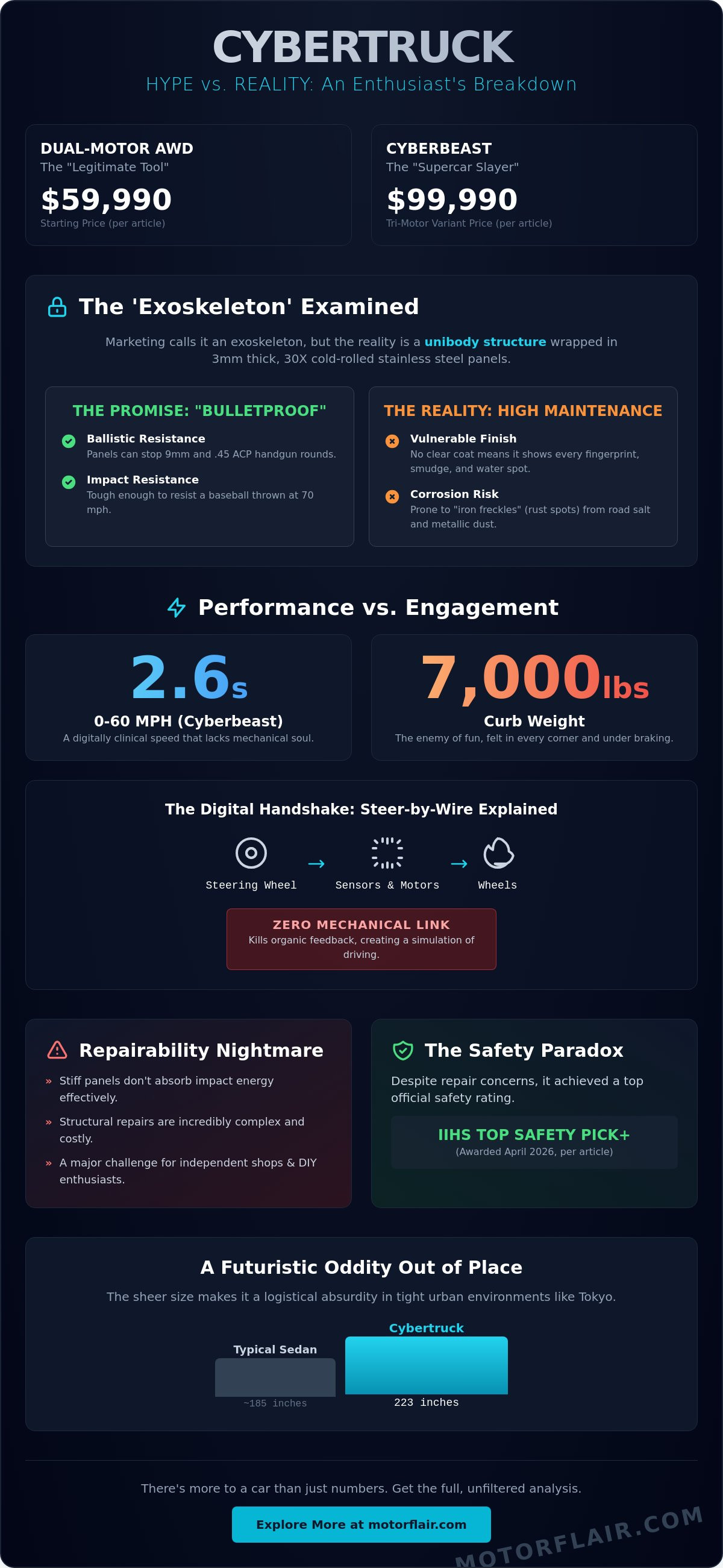
The marketing hype surrounding the "exoskeleton" suggests a structural revolution, but the reality is more grounded. If you dig into a Tesla Cybertruck overview, you'll see a unibody structure wrapped in 3mm thick stainless steel panels. It's tough enough to resist a baseball at 70 mph, yet it lacks the traditional clear coat that protects every other car in your garage. This leaves the metal vulnerable to the environment in ways most owners never anticipated.
Let's be clear about the "bulletproof" claims. While the 30X cold-rolled steel can stop 9mm and .45 ACP rounds, it isn't rated to any official military or NIJ ballistic standards. For the average enthusiast, the bigger concern isn't a shootout; it's the daily battle against fingerprints and rail dust. Without paint, your truck effectively becomes a giant, rolling kitchen appliance that shows every smudge and water spot.
To see how these materials hold up after months of real-world abuse, check out this detailed owner report:
Corrosion and Surface Contamination: Not Your Average Paint Job
"Stainless" is a bit of a misnomer. In coastal areas or regions where road salt is a winter staple, owners are reporting "iron freckles" within months of ownership. These tiny rust spots are actually metallic particles from the road that embed themselves in the steel and oxidize. Keeping a cybertruck clean is a unique maintenance mission. You aren't just washing a car; you're polishing raw metal with specialized cleaners to maintain that industrial sheen. It's a high-maintenance lifestyle that replaces wax and ceramic coatings with stainless steel wipes.
Crumple Zones vs. Cold-Rolled Steel
The trade-off for that dent resistance is a potential safety headache. In a traditional car, the body is designed to sacrifice itself to absorb kinetic energy. With panels this stiff, the energy of an impact has to go somewhere, and that usually means the passengers or the frame. While the IIHS awarded it a Top Safety Pick+ in April 2026, independent repair shops are sounding the alarm. Structural repairs on 30X stainless are incredibly complex, making minor accidents a high-stakes financial gamble for anyone outside the official Tesla service network.
Performance vs. Engagement: Does a 2.6-Second Sprint Equal Soul?
Let's be honest, speed is becoming a commodity in the EV world. The tri-motor Cyberbeast variant of the cybertruck clocks a 0-60 mph sprint in just 2.6 seconds. That's a figure that makes modern supercars sweat. It's an adrenaline-pumping surge that feels like a glitch in the Matrix, but for those of us who live for the mechanical symphony of an S65 V8, raw acceleration isn't everything. This truck is undeniably fast, but it's a clinical, digital speed that lacks the visceral crescendo of a true enthusiast machine.
This disconnect stems from the properties of its stainless-steel exoskeleton and a total reliance on electronic intervention to manage its massive footprint. To understand the mechanical reality, consider these core specs:
- Cyberbeast Acceleration: 0-60 mph in 2.6 seconds.
- Curb Weight: Approximately 7,000 lbs of stainless steel and lithium.
- Steering: Full steer-by-wire system with zero mechanical link to the wheels.
Steer-by-Wire: The Digital Handshake
This technology represents a crossroads for enthusiasts. There's no physical steering column, just a digital handshake between sensors and motors. While this allows for incredible maneuverability and a tight turning circle, it kills the organic feedback we expect. You don't feel the front tires searching for grip or the subtle road surface changes. It's a necessary evolution for a 7,000-pound beast, but it remains a simulation of driving rather than the real thing.
Weight and Physics: The Enemy of Fun
You can't ignore the grim reality of 7,000 pounds. Even with massive torque, you feel that battery pack through every corner and under heavy braking. Compared to the mechanical theater of a Ford Raptor or a RAM TRX, the cybertruck feels heavy and detached. Making such a massive EV feel nimble is a "Mission Impossible" for the laws of physics. If you prefer machines with more mechanical soul, check out our high performance vehicles coverage for a different perspective.
The Repairability Nightmare: DIY Logic vs. The Tesla Ecosystem
If you've ever spent a Saturday afternoon in your garage with a wrench and a dream, the cybertruck might feel like a personal affront. There's no paint to buff and no body filler to sand. Traditional body shops are legitimately terrified of this thing. Aligning 3mm stainless steel panels requires specialized tools and techniques that most independent shops haven't touched. It's a grim reality for the DIY crowd; minor fender benders that would cost $1,500 on a Ford F-150 can easily spiral into five-figure repair bills at a certified Tesla center.
This creates a walled garden that clashes with the independent tuning spirit we've championed for decades. By May 2026, the scarcity of certified repair centers has pushed insurance premiums to eye-watering levels. We're seeing a "Right to Repair" struggle play out in real-time. If you can't source parts outside the mothership, the modification ecosystem suffers. However, the aftermarket isn't giving up without a fight. Check out our latest Automotive news for updates on how the community is pushing back.
The Aftermarket Ecosystem: Beyond Wraps and Lightbars
Small businesses are finding creative ways to "fix" the Cybertruck's brutalist, almost sterile interior. From custom leather dash swaps to CNC-machined storage solutions, niche manufacturers are thriving. These independent shops are vital to keeping the enthusiast spark alive. They're proving that even a polygon can be personalized, moving beyond simple vinyl wraps to address the truck's utilitarian shortcomings. It's about turning a tech-bro appliance into something with a bit of character.
Long-Term Durability: Stainless Fatigue and Electronic Gremlins
We're now seeing how the 48V architecture handles years of enthusiast abuse. The 48V system reduces vehicle wiring weight by approximately 70 percent, allowing for smaller, more efficient electronic components throughout the chassis. While the weight savings are great, the complexity introduces new "Mission Impossible" scenarios for long-term troubleshooting. Mechanical soul is easy to maintain, but chasing electronic gremlins in a proprietary 48V loop is a different beast entirely. Let's face it, a truck that requires a software engineer to fix a door handle is a tough sell for the purists.
The Cybertruck in Tokyo: A Futuristic Oddity in the Kanto Region
Seeing a cybertruck roll through the neon-soaked streets of Shinjuku is a surreal experience. It looks like a low-poly asset that failed to load in a high-definition world. While Tesla has been touring the vehicle across Japan for promotional purposes throughout early 2026, it remains a futuristic oddity rather than a daily driver. The grim reality is that Japan’s strict pedestrian safety regulations regarding sharp vehicle edges make road-legal approval a massive hurdle for this stainless steel beast.
At 223 inches long, the physical presence is absurd. Navigating the narrow side streets of Ginza would be a logistical Mission Impossible even if it were road-legal today. Most automated parking towers in Tokyo simply aren't built for a 7,000-pound slab of steel. JDM purists, who value the mechanical precision of a NISMO-tuned Z or a high-revving Type R, often view it as a tech-bro status symbol rather than a legitimate enthusiast machine.
Capturing the beauty in this industrial grit requires a distinct perspective. To find the character hidden in those flat planes, specialized Commercial Car Photography is essential to translate the truck's presence into a compelling visual story. It's about finding the intersection between brutalist engineering and the organic flow of the city.
Tokyo After Dark: Shooting the Stainless Polygon
The stainless steel surface acts as a canvas for Shinjuku’s neon lights. Unlike traditional cars with flowing curves that create elegant highlights, the cybertruck offers harsh, geometric reflections. Shooting it requires a shift in mindset. You have to play with the brutalist angles to capture an essence that lacks any organic shape. It's about finding the symmetry in the chaos of the city's reflection and using the flat panels to bounce the ambient light of Tokyo in ways a painted car never could.
The 'Enthusiast Use Case' in Japan
Is it a valid choice for the Kanto region? Right now, it's a Ginza showpiece. Spoiler alert: even if regulations ease, the charging infrastructure for a 123 kWh battery in central Tokyo is a challenge. Most urban chargers are tucked into tight corners where a truck this size simply won't fit. It's a fascinating experiment, but for now, it's an alien visitor in a land that prizes precision engineering and compact efficiency over sheer geometric dominance.
The Future of the High-Octane Narrative
The cybertruck remains a rolling contradiction that forces every petrolhead to pick a side. It's a machine that offers a 2.6-second sprint while simultaneously asking us to accept a total lack of mechanical steering feedback. The May 2026 reality behind the 30X stainless steel is clear; it's less of an indestructible shield and more of a high-maintenance canvas for fingerprints and iron freckles. From the repairability nightmare of its 48V architecture to the sheer absurdity of its 223-inch frame on Tokyo's narrow streets, this truck proves that technology doesn't always equal engagement.
Your connection to a vehicle with genuine character is a story worth telling. We bring an expert Tokyo-based perspective and a purist enthusiast voice to every project, focusing on high-resolution visual storytelling that respects the machine. If you've poured your soul into a build, it deserves to be documented with the same level of passion. Immortalize your high-performance build with MotorFlair's Private Portraits. Let's celebrate the mechanical life together.
Frequently Asked Questions
Is the Cybertruck actually bulletproof against real-world threats?
No, it isn't officially bulletproof according to any military or NIJ ballistic standards. While the 30X cold-rolled stainless steel can resist 9mm and .45 ACP handgun rounds, it won't stop high-velocity rifle fire. The armored glass is equally limited; it's designed to withstand a baseball at 70 mph but isn't rated for ballistic protection. It's a tough truck, but don't expect it to survive a tactical engagement.
Can you repair a dent in a Cybertruck's stainless steel panel?
Repairing a dent in the cybertruck is significantly more complex than on a traditional painted vehicle. Because the panels are 3mm thick and lack a clear coat, you can't use standard body filler or paintless dent repair techniques. Most structural damage requires a complete panel replacement at a certified Tesla center. This specialized repair process is a major factor in the high insurance premiums owners face in 2026.
How does the Cybertruck's steer-by-wire system feel compared to a traditional rack?
The steer-by-wire system feels digital and entirely disconnected compared to a traditional mechanical rack. There's zero physical link between your hands and the front wheels. While the variable steering ratio makes parking a 7,000-pound beast easier, you lose the organic road feedback that defines a true driver's car. It's a precise simulation of steering, but it lacks the visceral communication of a performance-tuned mechanical setup.
Will the Cybertruck's stainless steel rust in snowy or coastal climates?
Yes, the stainless steel can develop surface corrosion in environments with high salt exposure or coastal air. Many owners have reported "iron freckles," which are tiny rust spots caused by metallic road debris embedding in the raw steel and oxidizing. Since the cybertruck lacks a protective clear coat, maintaining the finish requires frequent cleaning with specialized stainless steel polishes. It's a high-maintenance reality that replaces traditional waxing.
Is the Cybertruck too big to drive in cities like Tokyo or London?
Driving this vehicle in Tokyo or London is a logistical nightmare due to its 223-inch length and massive width. Most urban parking towers and narrow side streets simply aren't built for a slab of steel this size. Pedestrian safety regulations in Japan regarding sharp edges also create significant legal hurdles for road approval. It's a truck designed for wide American highways, not the compact, historic infrastructure of international cities.


